Our CEO, Anne-Marie Douglas, launches her report Towards a System that Heals.
It’s been years in the making, and the empathy journey continues through Peer Power’s work. In this report, supported by the Churchill Fellowship, Anne-Marie explores empathy in education, social care & justice through her Fellowship research travels across the USA and Canada.
Excerpt from the Empathy Report: Towards a System that Heals (Anne-Marie Douglas, 2022)
“The principles of compassion call us to treat all others as we wish to be treated ourselves, to alleviate suffering for others.”
In the context of thinking about empathy in public services, such as health, justice and social care services, it is important to explore ‘compassion fatigue’ and ‘vicarious trauma’.
Compassion fatigue is also known as secondary traumatic stress and vicarious trauma and, as the name suggests, is an indication that overexposure to repeated trauma causes a gradual lessening of compassion over time, with emotional and psychological effects resulting from indirect exposure to the details of the traumatic experiences of others, and feelings of being committed to, or responsible for helping them.
An easy example of compassion fatigue in the public domain might be the charity adverts that we see on television or on advising boards. Though they display distressing images, they do not always result in compassionate action from the viewer. Another obvious example is that of a busy health practitioner who cares for multiple patients in various stages of pain over a prolonged period. Less obvious is the recurrent emotional stress that can occur in helping professions where ‘emotional labour’ is required. Also termed as ‘emotional burnout’, it can result in numbness, disconnection, depression, difficulties with communication, sleeping, stress and anxiety.
It has been defined by Dr. Charles Figley as“…a state experienced by those helping people or animals in distress… an extreme state of tension and preoccupation with the suffering of those being helped to the degree that it can create a secondary traumatic stress for the helper.”
“Compassion can be defined in many ways, but its essence is a basic kindness, with a deep awareness of the suffering of oneself and of other living things, coupled with the wish and effort to relieve it.” – PAUL GILBERT
He argues that compassion fatigue symptoms are normal displays of chronic stress resulting from the caregiving work we choose to do. Leading traumatologist Eric Gentry suggests that people who are attracted to being a caregiver by occupation are already compassion fatigued. They often identify strongly with people who are suffering and who have experienced trauma, so that will be their motive.
He uses the term ‘other-directed caregiving’ to describe those who were taught from an early age to care for the needs of others before caring for their own needs, and therefore ongoing, consistent and authentic caregiving practices are absent from their own lives.
Simon Baron-Cohen in his book Zero Degrees of Empathy describes a bell curve of empathy and believes that we all lie somewhere on an empathy spectrum. There can be fluctuations in our empathy levels day-to-day but we broadly fit into a category on a scale from 0 to 6, with 0 being an individual with no empathy at all, and 6 being individuals with remarkable empathy, and continuously fixed on the feelings and experiences of others. He advocates for the terms ‘low/lack of empathy’ or ‘empathy erosion’ rather than ‘evil’ to describe those acts that happen when humans hurt each other, arguing that the term ‘evil’ is not helpful in our understanding of why some people come to commit crimes and atrocities.
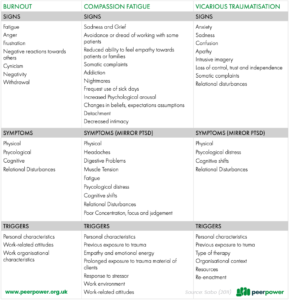
These levels are used to differentiate aspects of empathy but in fact for most of us, what occurs is a seamless movement between levels on an empathy continuum. Those most naturally empathic people, around level 6, he describes as having an empathy circuit that’s hyper-aroused, and potentially with a focus solely on others, which can mean that a person neglects their own needs, so it seems that some people can over empathise to a point where it’s harmful.
Sometimes people comment on others’ lack of empathy in helping professions that rely on human care, connection and engagement: for example, a doctor, a social worker, or a teacher. However, rarely do we comment on a person who ‘over empathises’; the person that takes on and feels the pain of others around them, at home, and at work. Sometimes called ‘empathy fatigue’ in the helping professions, it’s arguably the reason why some people can be very ‘boundaried’ in their engagement, and with people in the helping professions concerned with the threat of ‘burnout’ and ‘secondary trauma’ it can seem easier, more professional and certainly safer to stay ‘distanced and boundaried’ in relationships with young people. If we become consumed with other people’s feelings and trauma, there is the risk that we might suffer as a result. Over empathising can result in vicarious and secondary trauma resulting in burnout.
Researchers have found, for example, that the more empathic the parent, the more likely that person was to be experiencing chronic low-grade inflammation. The researchers speculate, “Parents who readily engage with the struggles and perspectives of others may leave themselves vulnerable to additional burdens, expending physiological resources …to better help others.”
Philosopher Roman Krznaric believes that empathy has the power both to transform our lives and to bring about fundamental social change. He talks of ‘empathy over-arousal’ but states that “empathy over-arousal is a serious problem, but we should remember that it affects only a minority of people”.
Bruce Perry, in his book Born for Love, speaks of over-empathy and how this can ‘backfire because empathy and disgust are fired up in the same brain region, giving an example of an over-empathizing person reacting with disgust on their face to a person with facial disfigurement. The empathy comes from imagining the pain the other person has been through, but the response is disgust or horror.
Another study found that over-empathic nurses were more likely to avoid dying patients in their training before they had learned to deal with the distress caused by empathising too much.
Which perspective we take when responding to someone else’s suffering can sometimes affect our own health and wellbeing. In an upcoming study in the Journal of Experimental Social Psychology, researchers assigned more than 200 college students to act as a helper to what they were told was a fellow student going through a personal crisis. Each participant was asked to read a personal essay detailing the supposed student’s financial struggles and stress upon becoming the primary caregiver for a younger sibling after the death of their mother. While reading the text, a third of the volunteers were asked to think about how that person must be feeling (compassionate empathy) and a third were asked to imagine how they would feel if they were that person (emotional empathy). A control group was asked to stay detached and remain objective. Researchers then measured the participants for various physiological markers, including hormone stress levels, heart rates and blood pressure. They found that those who put themselves in the other person’s shoes had significantly higher ‘fight-or-flight’ responses, as though they, too, were going through a stressful experience.
Researcher Anneke Buffone notes, “the chronic activation of the stress hormone cortisol could lead to a variety of serious health issues like cardiovascular problems, a finding that is particularly meaningful for health professionals who are confronted with others’ pain and suffering daily.”
By contrast, the brain also releases the hormone oxytocin when we interact with others in a caring way. Oxytocin is known to have anti-stress and anti-depressant effects, so it turns out that empathy can also be good for our well-being… (The Washington Post, n.d.). “Neuroscientific research on empathy shows that if you’re empathising with a person who is in pain, anxious or depressed, your brain will show activation of very similar circuits as the brain of the person with whom you’re empathizing,” notes Richard Davidson, a professor of psychology and psychiatry at the University of Wisconsin at Madison.
Keep up with the latest on empathy, co-production and youth-led system change.





Website by Eyes Down Digital