By Jesse Gillespie
Content warning: The works of this article explores the themes of anti-LGBTQ+ violence and discrimination, which some readers may be sensitive to and find distressing. Please read with care.

Why LGBT+ History Month?
Every February the UK celebrates LGBT+ History Month, a time to recognise the achievements and contributions of LGBTQ+ people, whilst raising awareness of ongoing discrimination that they face. It’s vital that we use this month, and the rest of the year, to showcase work of LGBTQ+ people as their history has constantly been buried. This month creates a space where we can come together as a community from amplifying LGBTQ+ voices, celebrate where we are now and create our own future. As well as celebrating achievements of the LGBTQ+ community, it’s important to note the anti-LGBTQ+ violence and censorship that this community have been through and still face to this day.
As a social justice charity, Peer Power Youth strives to live its values through understanding and learning from other stories and providing young people with equal opportunities to social justice. We invite everybody to celebrate LGBT+ History Month with us and learn from each other whilst highlighting the strong and powerful voices of the LGBTQ+ community.
“A lot of people don’t know about LGBT+ History Month, so it’s important to have historical context.”
Recognising Trailblazers

Martha P Johnson was a Black transgender activist – a huge figure in the gay rights movement between 1960s-70s in New York – advocating for homeless LGBTQ+ youth, transgender people and those effected by HIV. On June 28, 1969, police raided The Stonewall Inn – a gay bar inNew York – in the early hours of the morning, arresting customers, and causing The Stonewall Riots, a fight for the oppression and fear that LGBTQ+ people faced. Johnson was a part of these riots, protecting her friends and family in a key moment in protesting for equality. Her body was found in the Hudson River in 1992, and although ruled a suicide, many of her friends and following believe her to be a victim of anti-LGBTQ+ violence. Johnson’s activism had a huge role in starting Pride protests all over the world.
“Queer people of colour have fought for many different movements and this history can be whitewashed”
Lasting Impact of Section 28
In 1988 England faced a ban of the “promotion of homosexuality” from local authorities and schools, making it illegal to discuss anything relating to the LGBTQ+ community in these settings. Since this was overruled in September 2003, there has had a lasting impact on today’s education. As LGBTQ+ history and healthcare were and still can be left out of the school curriculum, there are fewer people educated on historic events, such as the 1969 Stonewall Riots. Section 28 also created a generation gap, with less people being educated during this time means less knowledge on different LGBTQ+ identities.
This was long before communities were created on social media, and these online spaces can give queer people a space to talk to others and express themselves. Even though there is still a long way to go for the liberation of queer people in England, with violent anti-LGBTQ+ violence still taking place and a lack of knowledge and healthcare, it’s important to note how far we have come with more young people being able to fully embrace their identity.
“There needs to be more education in schools and the community about different identities”
LGBTQ+ History Month vs Pride Month
More commonly known than LGBT+ History Month is Pride Month, which takes place in June across different cities around the world. Pride month often covers annual events such as parades, concerts, and parties. Although Pride Month historically started as protests for LGBTQ+ rights, now it’s generally more commercialised towards corporate brands. The first Pride marches occurred on the one-year anniversary of the Stonewall Riots, when thousands of LGBTQ+ people protested a demonstration for equal rights. As the fight for equal rights grew, so did Pride.
The impact of Pride has had a huge impact on the world, with millions of people now taking part in different Pride events every year. It’s been a concern with many members of the LGBTQ+ community of the more recent commercialisation of Pride Month means that large brands, such as supermarkets and banks, generate income as a result when they are not contributing to the continuing fight for equality, rather than money being raised for charities to help the LGBTQ+ community.
The difference between Pride Month and LGBT+ History Month, is that in February we recognise and honour our history and diversity of the community. Whilst both months are important for supporting the LGBTQ+ community, they have different focuses and traditions. This is why it’s so important to talk about LGBT+ History Month, to be able to celebrate where we are at now, and the history and achievements of LGBTQ+ people.
“It’s never been illegal to be straight.”

Celebrating Ourselves
The LGBTQ+ community has been through a lot, and we still have a long way to go in terms of fighting for equality, which is why celebrating queer visibility is so important. By being able to reclaim our own narratives, we fight for the recognition that we deserve as individuals and as a community.
As I write this I am comfortable and open with identifying as Queer and have many openly LGBTQ+ people both at work and in my personal life. It’s connecting with these people that makes being in this community so special and meaningful to me. Working with a charity that allows me to amplify my own voice as a queer person empowers me and encourages me to connect with others, to hopefully make more and more people feel comfortable with their own identities.
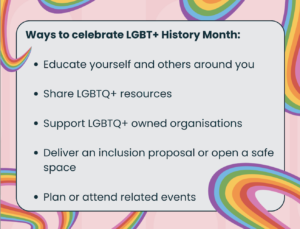
We invite you to celebrate LGBT+ History Month by educating yourself with the further reading bellow, sharing LGBTQ+ resources and stories, supporting LGBTQ+ owned organisations, delivering an inclusion proposal or open a safe space, and attending LGBTQ+ related events.
“Important to be open and talk about it so other people can relate and feel more comfortable.”
Recommended Reading
WATCH The Death and Life of Marsha P. Johnson.
WATCH Pride, a fictional movie based on true events.
VISIT Brighton Museum, ‘Queer the Pier’ exhibition on the local LGBTQ+ History.
VISIT the UKs first and only LGBTQ+ museum, Queer Britain.
BROWSE the official LGBT+ History month website:
Language Disclaimer
This article refers to the official LGBT+ History month. When speaking about the community LGBTQ+ has been used, whilst encompassing all individuals the synonym may not accurately reflect their identity.
Quotes are from members of the Peer Power Youth community.
If you need someone to talk to…
LGBTQ+ Switchboard Helpline / 0300 330 0630 / https://switchboard.lgbt/
Gendered Intelligence / 0330 3559 678 / https://genderedintelligence.co.uk/
Galop / 0800 999 5428 / https://galop.org.uk/
The Mix / 0808 808 4994 / https://www.themix.org.uk/
Keep up with the latest on empathy, co-production and youth-led system change.





Website by Eyes Down Digital